




What period do the Riace Bronzes belong to?
The Riace Bronzes date back to the 5th century BC, one of the highest moments of classical Greek art. Scholars place their creation between 460 and 430 BC, a crucial period for the definition of the aesthetic principles that shaped Western art.
They were created at a time when Greek sculpture achieved a perfect balance between idealization and realism, physical strength and harmonious proportions. This makes the Riace Bronzes direct witnesses to an artistic tradition that profoundly influenced all subsequent art history.
What do the Riace Bronzes represent?
The two Bronzes depict nude warriors, sculpted with remarkable realism. They are not individual portraits, but idealized figures, probably mythological heroes or legendary characters. Some theories link them to the myth of the Seven Against Thebes, while others interpret them as commanders or symbols of heroic virtue.
In classical Greek art, nudity does not signify vulnerability, but rather expresses strength, physical perfection, and the ideal of humanity. The Bronzes embody the Greek concept of man as the measure of all things.
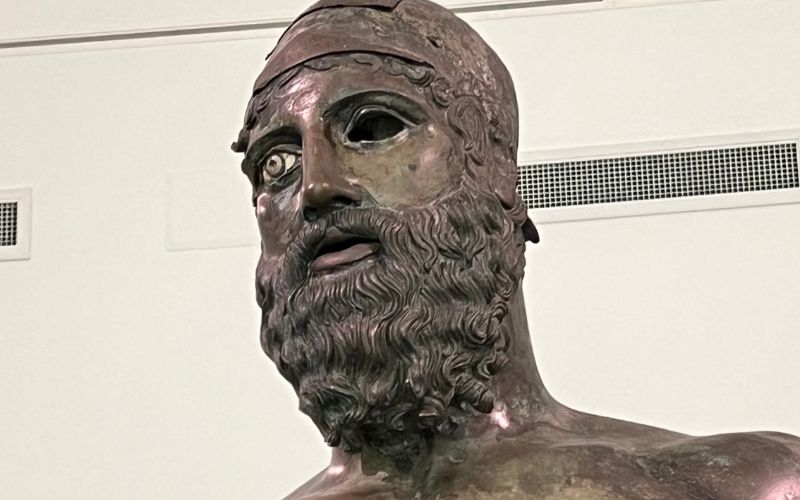
The differences between Bronze A and Bronze B
Although often considered a homogeneous pair, the two Bronzes display clear differences that make them even more fascinating.
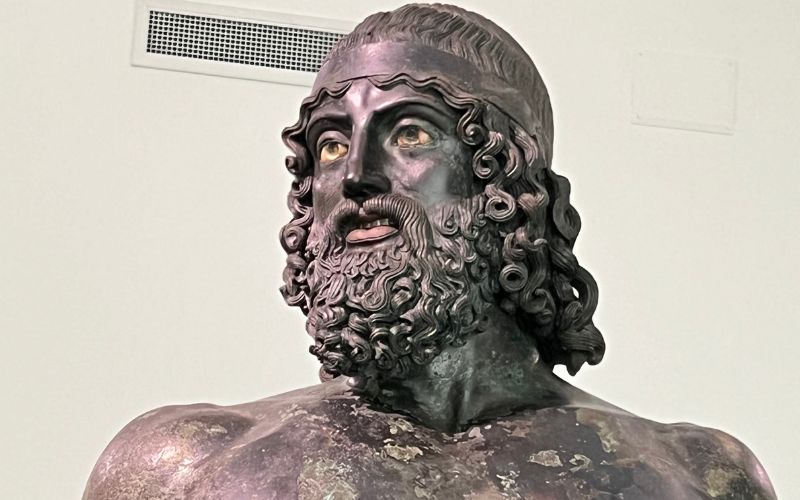
Bronze A appears younger and more dynamic. His posture is energetic, his gaze proud, and his body seems ready for action. He conveys strength, tension, and confidence.
Bronze B, by contrast, has a more mature appearance. His posture is more composed, his facial expression more severe and thoughtful. He conveys authority and control.
These differences suggest that the statues were likely created by two different artists, both active during the same historical period, making the group even more valuable from an artistic point of view.
How the Riace Bronzes were made
The Riace Bronzes were created using the lost-wax casting technique, an extremely complex process that allowed artists to produce hollow yet durable statues.
Bronze is not the only material used, the eyes are made of different materials such as glass paste and ivory, the teeth are silver, while the lips and nipples are copper. This combination of materials gave the statues an incredibly realistic, almost “lifelike” appearance.
The fact that the statues are hollow played a crucial role in their exceptional preservation, allowing them to survive for centuries on the seabed.
Why were the Riace Bronzes found in the sea?
One of the great mysteries surrounding the Riace Bronzes concerns why they ended up in the sea. The most widely accepted theory is that the statues were being transported by ship, possibly destined for a city of Magna Graecia or mainland Greece.
During a storm or shipwreck, the crew may have decided to throw them overboard to lighten the vessel. This would explain why the statues were found without their original context and why they were never recovered in antiquity.
This unresolved mystery adds even more fascination and intrigue to an already extraordinary story.
Where are the Riace Bronzes today?
Today, the Riace Bronzes are preserved and displayed at the National Archaeological Museum of Reggio Calabria, one of the most important museums in southern Italy. The statues are housed in a specially designed room with constant temperature and humidity control to ensure perfect conservation.
The museum also hosts numerous artifacts related to Magna Graecia, making the visit a complete and immersive journey into Calabria’s ancient history.
Why are the Riace Bronzes so important?
The Riace Bronzes are considered among the most important Greek sculptures in the world because they are original bronze works from the classical period, not Roman copies. Most ancient Greek bronze statues were destroyed over time, making these two works truly unique and irreplaceable.
Their monetary value is incalculable, but their cultural value is even greater: they have become a symbol of Calabria’s identity and one of the highest expressions of Western art.
Visiting the Riace Bronzes during a holiday in Calabria
Including a visit to the Riace Bronzes in your itinerary is an excellent idea even for those staying along the Coast of the Gods, between Tropea, Capo Vaticano, and Formicoli. A day trip to Reggio Calabria allows you to discover a different side of the region, combining sea and culture.
The museum visit usually takes about one hour, though it may last longer for those who wish to explore in greater depth. The Reggio Calabria seafront, considered one of the most beautiful in Italy, perfectly completes the experience.
When to visit the Riace Bronzes
The Riace Bronzes can be visited all year round, making this experience ideal even during less crowded periods. In summer, they offer a pleasant alternative to the hottest hours of the day, while in spring and autumn they are perfect for enriching a cultural holiday.
Why include the Riace Bronzes in your trip
Visiting the Riace Bronzes means discovering the oldest and deepest soul of Calabria. It is an experience that completes the journey, giving meaning to the territory and telling a millennia-old story that goes far beyond the beaches.
If you are staying along the Coast of the Gods, dedicating a day to the Riace Bronzes is one of the best ways to make your holiday truly complete and unforgettable.